
Knox County, Tennessee, 2027-2031 Capital Improvement Plan (CIP) Alert
How Did Knox County, Tennessee’s Capital Spending Change Between the Last Two CIPs?
The Knox County capital improvement plan for 2027-2031 totals $334.4 million. That is $5.1 million (1.5%) less than the 2026-2030 plan’s $339.5 million. The adopted 2027-2031 plan funds 58 distinct projects, down from 60. Its average project is slightly larger, at $5.76 million against $5.66 million. For vendors tracking the Knox County CIP, the overall program is close to flat from one edition to the next.
Table 1. Knox County, Tennessee CIP: edition-over-edition comparison
| Metric | 2026-2030 | 2027-2031 |
|---|---|---|
| Total CIP value | $339.5 million | $334.4 million |
| Distinct project count | 60 | 58 |
| Average project value | $5.66 million | $5.76 million |
Totals count only the dollars each plan programs in its own five years.
The shift looks like a re-phasing, not a smaller program. Two fewer projects and a modest dip in dollars leave slightly more money per project. The large education and highway lines stay essentially where they were, so school infrastructure projects and road improvement projects remain the core of the Knox County capital improvement plan.
Which Departments Saw the Largest Changes in Knox County, Tennessee’s CIP?
Table 2. Five largest department moves
| Department | 2026-2030 | 2027-2031 | $ change | % change |
|---|---|---|---|---|
| Countywide Projects | $9.1 million | $1.0 million | −$8.1 million | −89.0% |
| Building Improvements/Major Maintenance | $8.4 million | $11.1 million | +$2.7 million | +31.9% |
| Parks and Recreation | $1.0 million | $1.4 million | +$0.4 million | +38.5% |
| Major Equipment | $21.0 million | $21.2 million | +$0.2 million | +0.9% |
| Knox County Schools | $216.4 million | $216.2 million | −$0.2 million | −0.1% |
These are the plan’s own department totals over each plan’s own years.
Countywide Projects drove the overall change. Its $8.1 million cut is larger than the whole net decline in the Knox County CIP. Building Improvements/Major Maintenance absorbed part of that cut, rising $2.7 million. Knox County Schools ($216.2 million) and Engineering and Public Works ($83.0 million) were each nearly unchanged. Together they still carry most of the plan’s dollars.
What Are the Largest Projects in Knox County, Tennessee’s 2027-2031 CIP?
- Mechanicsville/Lonsdale/Beaumont Solution: $67.7 million (Streets and Roads)
- South Knox Solution: $51.9 million (Streets and Roads)
- HVAC Upgrades: $30.0 million (Educational Facilities)
- Canton Hollow Rd Improvements: $16.5 million (Streets and Roads)
- Other Equipment-Various: $16.0 million (Vehicles)
Below the top five, the list is dominated by road improvement projects and school infrastructure projects. Examples include Schaad Rd ($14.2 million), Northshore Improvements ($12.0 million), and Roof Upgrades and Security Upgrades for schools ($15.0 million each).
How Is Knox County, Tennessee’s CIP Governed and Approved?
Knox County policy limits the CIP to construction projects and capital purchases that generally cost more than $100,000 in total and/or have a useful life of more than seven years. Smaller purchases and routine maintenance go in the operating budget [1][2]. The plan’s stated purpose is to plan, schedule and anticipate financing for capital projects over the next five years [1].
Department heads and elected officials prepare project proposals and submit them to the Finance Department. The Public Building Authority helps calculate project costs and schedules [1]. Knox County Schools’ proposals are forwarded to the Finance Department only after the Knox County School Board adopts its own request [1]. The school system adopted an $82,011,000 FY2027 capital budget alongside its general purpose budget [9].
The County Mayor proposes the plan. Mayor Glenn Jacobs sent his proposed FY 2027–FY 2031 Capital Plan to the County Commission on May 11, 2026 [1]. The memo said the five-year total was $334.4 million, that the plan assumed no new taxes for debt service, and that 89.5% of the funding was for education and for engineering and public works [1]. It also said the plan would raise county debt by $18.1 million over the five years, because new general obligation bond issuance would exceed scheduled principal payments by that amount [1].
The Knox County Commission adopts the plan. It approved Resolution R-26-6-103-SS, which adopts the Five-Year CIP for Fiscal Years 2027-2031 and appropriates funds for its first year, by a 7-3-0-1 vote [3]. Before that vote, a substitute motion to remove $64,661,000 for a new school facility and related debt failed 3-7-0-1 [3]. Only the first year is appropriated; later years are planning figures [8]. The County describes the five-year plan as “a road map of anticipated major capital projects” that “does not represent appropriations” and is revised every year [4]. The previous plan was adopted on June 1, 2024 [4].
Projects are mainly funded with general obligation bonds [4]. The County generally issues capital debt once a year, timed as close as practical to planned spending [4]. The FY 2026-27 budget was approved without a property tax increase [7].
What Is the History of Knox County, Tennessee and Its Infrastructure?
Knox County was formed on June 11, 1792 [10]. It had 478,971 residents at the 2020 census, making it Tennessee’s third-most populous county [11]. Its county seat is Knoxville, with an estimated 199,234 residents as of July 1, 2025 [12]. The county government is led by an elected County Mayor, who proposes the budget and CIP, and a County Commission, which approves them [7].
In fiscal year 2025, the County’s Engineering & Public Works department maintained 1,761 lane miles of streets, 142 bridges and 92 traffic signals [4]. The County also operated 59 parks covering 2,815 acres, 4 splash pads, 30 recreation courts, 3 golf courses and 7 dog parks [4]. Engineering and Public Works reviews development plans under the County’s small MS4 stormwater permit. Review covers sites that disturb 1 acre or more, or that add 10,000 square feet or more of impervious area [6]. In 2025 the County also led an update of its multi-jurisdictional hazard mitigation plan, which each participating jurisdiction adopts by resolution [5].
Fun Facts About Knox County, Tennessee
- The Tennessee River begins in Knox County, where the Holston and French Broad rivers meet. Knoxville was founded at that confluence in 1791 [11].
- Knoxville grew out of James White’s Fort, built in 1786 near the mouth of First Creek by Revolutionary War officer James White and his friend James Connor [13].
- Territorial Governor William Blount first wanted his capital at Kingston. When the Cherokee refused to cede that land, he chose White’s Fort, and in 1792 the settlement became capital of the Southwest Territory under the name Knoxville [13].
- The Treaty of the Holston (1791) came out of meetings Blount held near White’s Fort [13].
- Blount Mansion (1792) was Blount’s home and the territorial capitol. Tennessee’s first state constitution was drafted there, which gave Knoxville the title “Birthplace of Tennessee” [14].
- White’s cabin is the only original part of the fort still standing. It was taken apart and moved several times before being reassembled as part of a downtown museum built in 1970 [13].
- The 1982 World’s Fair, themed “Energy Turns Our World,” drew more than 11 million visitors. It is recognized as the last successful World’s Fair held in America [15].
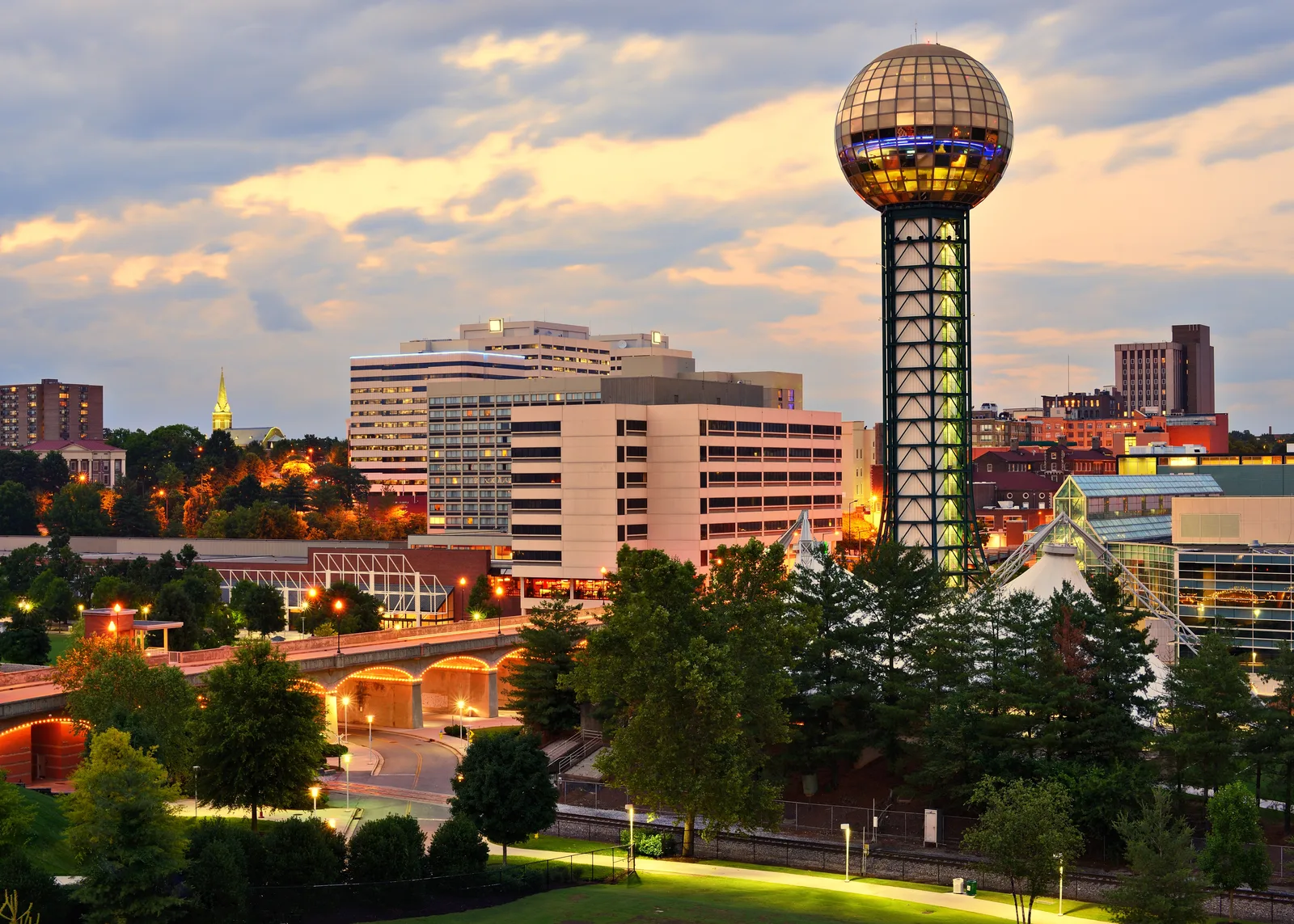
- The fair’s Sunsphere is a 266-foot steel truss tower topped by a 75-foot gold-colored glass sphere. It and the Tennessee Amphitheater are the only two structures left from the fair [16].
How FirmoGraphs Can Help?
FirmoGraphs tracks public capital improvement plans across the country and flags edition-over-edition changes like this one: which departments are growing, which projects are new, and where dollars are shifting between years. That lets A/E firms, contractors and technology vendors engage agencies before solicitations are released. Learn more at FirmoGraphs.
References
Notebook (agency documents): [1] 2026-2027 Proposed Operating Budget and 2027-2031 Capital Improvement Plan — notebook — 2026-2027 Proposed Operating Budget and 2027-2031 Capital Improvement Plan (pp. 41–42) [2] FY27 Adopted Budget Book, Capital Improvement Plan Policy — notebook — FY27 Adopted Budget Book (p. 29) [3] Knox County Commission minutes, Resolution R-26-6-103-SS — notebook — 06 15 2026 bss (p. 4) [4] Knox County, Tennessee Annual Comprehensive Financial Report, FY2025 — notebook — 2025acfr (pp. 14, 38, 360) [5] Knox County Multi-Jurisdictional Hazard Mitigation Plan Update (2025) — notebook — [PDF] Knox County Hazard Mitigation Plan Update (pp. 25, 211) [6] Knox County Permanent Stormwater Implementation Plan — notebook — KCPermanentStormwaterImplementationPlan (p. 6)
Web sources: [7] Mayor Jacobs weekly update, June 2026 — web — https://knoxvilledailysun.com/news/2026/june/mayor-jacobs-weekly-update-june-18.html [8] Knox County budget hearing meeting summary — web — https://app.govly.com/public/meetings/36274 [9] Knox County Schools FY2027 Budget Book — web — https://public.destinyhosted.com/knoxsdocs/2026/CALLMT/20260423_816/9651_FY2027BudgetBook.pdf [10] The Founding of Knox County — web — https://www.knoxcountylibrary.org/the-founding-of-knox-county [11] Knox County, Tennessee — web — https://en.wikipedia.org/wiki/Knox_County,_Tennessee [12] QuickFacts: Knoxville city, Tennessee — web — https://census.gov/quickfacts/fact/table/knoxvillecitytennessee/PST045223 [13] James White’s Fort — web — https://en.wikipedia.org/wiki/James_White%27s_Fort [14] Fun Facts About Knoxville — web — https://www.knoxvilletn.gov/visitors/knoxville_info/fun_facts_about_knoxville [15] World’s Fair Park History — web — https://www.worldsfairpark.org/visit-us/history [16] When the World Came to Knoxville: The Sunsphere — web — https://www.wuot.org/2022-06-02/when-the-world-came-to-knoxville-the-sunsphere
Frequently asked questions
- What is the total of the new Knox County capital improvement plan?
- The 2027-2031 plan totals $334.4 million across 58 projects, counting only the dollars programmed in its own five years.
- How much did the Knox County CIP change from the previous plan?
- It fell $5.1 million (1.5%) from the 2026-2030 plan's $339.5 million, and the project count dropped from 60 to 58.
- What are the biggest projects?
- The largest are the Mechanicsville/Lonsdale/Beaumont Solution ($67.7 million), the South Knox Solution ($51.9 million) and HVAC Upgrades ($30.0 million).
- Which areas grew most?
- Building Improvements/Major Maintenance rose $2.7 million (+31.9%) and Parks and Recreation rose $0.4 million (+38.5%). Countywide Projects fell $8.1 million.
- When and how was it adopted?
- The County Commission adopted the plan, and appropriated its first year, through Resolution R-26-6-103-SS by a 7-3-0-1 vote. Years two through five remain planning figures [3][8].
- How is the plan funded?
- Mainly through general obligation bonds. The Mayor's proposal projects an $18.1 million net increase in debt over the five years and assumes no new taxes for debt service [1][4].