


FirmoGraphs keeps its clients up to date on capital plans of interest for long-term business development. We help our customers use this information to gain a competitive advantage and improve proactive conversations with their clients. We recently processed the latest capital spending plan by City of Bozeman. Here are our observations.
The proposed 2027–2031 Capital Improvement Program (CIP) for the City of Bozeman totals approximately 288.7 million dollars, a modest 2% increase over the prior 2026–2030 plan. While overall investment remains stable, spending priorities shift in meaningful ways. Public Safety (+105%) and Public Welfare (+51%) see significant increases, signaling a stronger emphasis on community services, housing, and safety initiatives. Public Works, though slightly reduced (−3%), still accounts for the vast majority of planned capital spending, driven by major water and transmission infrastructure projects. The addition of a new “Multiple” category further points to growing cross departmental and technology related investments.
Overall, the proposed CIP maintains strong core infrastructure funding while reallocating resources to support safety and community focused priorities. For vendors, this suggests a market where water and transmission projects remain foundational, but there is rising opportunity around public safety facilities, social infrastructure, and cross cutting technology and coordination efforts.
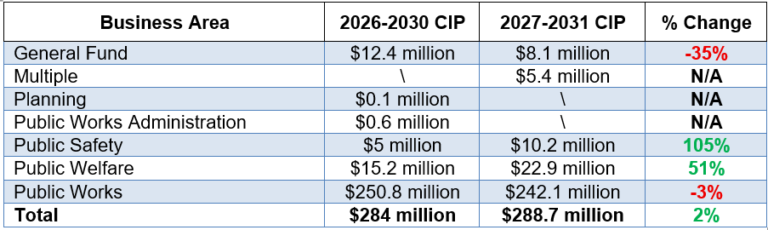
Spending Trend Summary
The City’s overall capital spending remains stable between the two planning periods, with only modest growth in total investment. Public Works continues to represent the largest share of funding, though its proportion declines slightly as other service areas expand their share of the program. Several major utility and transmission projects are phased into later years, smoothing peak expenditures across the cycle and creating a more even runway of work rather than a single spike. Taken together, these patterns reflect steady infrastructure investment alongside a gradual diversification of capital priorities – a useful signal for vendors planning multi-year engagement.
Top 3 Projects 2027-2031 CIP
Three major water and transmission initiatives anchor Bozeman’s upcoming CIP cycle.
- Western Transmission Main / New South Pressure Zone — $17.8 million, a major water system expansion to add transmission capacity and establish a new south pressure zone to support growth and improve system reliability. This project creates a multi-year platform for firms focused on transmission design, construction, pressure management, and long term system optimization.
- Lyman Tank & Transmission Main — $17.4 million, Construction and upgrade of water storage at the Lyman Tank and associated transmission main improvements to strengthen storage, pressure, and delivery capacity. Vendors in storage facilities, pumping, and control systems can position around reliability, redundancy, and future growth demands.
- Water Pipe Replacement Program — $16.7 million, An ongoing renewal program replacing aging water mains to reduce breaks and leaks, improve service reliability, and extend asset life across the distribution system. The programmatic nature of this work favors partners who can deliver repeatable renewal solutions, data driven asset management, and efficient construction methods.
City of Bozeman Capital Plan Approval and Governance
Bozeman’s Capital Improvement Plan (CIP) is developed by City departments and the Finance team and is prepared and submitted by the City Manager to the City Commission as a multi year capital program, with the City Charter setting a December submission deadline. The City Commission reviews the recommended CIP in work sessions and then adopts it by resolution, using it as a planning guide for budget development. Importantly, CIP adoption does not itself grant budget authority or commit the City to construct projects—funding is authorized through the adopted budget and, when needed, subsequent budget amendments. The CIP is maintained in alignment with applicable legal requirements, including state requirements tied to specific funds such as impact fees. For vendors, monitoring the CIP cycle, commission discussions, and follow on budget actions is essential to seeing opportunities early and timing outreach before projects convert into procurements.
Source: December 2023 Memorandum: https://d2kbkoa27fdvtw.cloudfront.net/bozeman/fec9b32e9e6bf486816004ae7d5c01140.pdf
History Bozeman, Montana
Bozeman was founded in 1864, when pioneers John Bozeman, Daniel Rouse, and William Beall platted a townsite in the Gallatin Valley, helping establish it as a supply and settlement hub during Montana’s early growth. The community expanded rapidly after incorporating in 1883, the same year as the Northern Pacific Railroad reached Bozeman, fueling a building boom along Main Street and strengthening regional trade connections. By the late 1800s and early 1900s, Bozeman was becoming more urban, with amenities like electric infrastructure and streetcars reflecting its transition from frontier settlement to established city.
Sources: Bozeman, Montana Wikipedia: https://en.wikipedia.org/wiki/Bozeman%2C_Montana, Advisory Council on Historical Preservation: https://www.achp.gov/preserve-america/community/bozeman-montana,
Fun Facts about Bozeman, Montana
- Gateway to Yellowstone National Park – Bozeman is located just 90 minutes from Yellowstone, making it a prime basecamp for exploring one of the world’s most iconic national parks.
- Home to Montana State University – The city’s a home to Montana State University, which contributes Division I athletics, cultural events, research activity, and a vibrant college town atmosphere.
- World-Class Outdoor Recreation – The city’s setting near the Bridger, Gallatin, and Madison ranges supports world class outdoor recreation, including skiing, hiking, fly fishing, mountain biking, and climbing.
- Charming & Historic Downtown – A preserved, historic downtown along Main Street—with 19th century architecture, local shops, galleries, breweries, and farm to table dining—rounds out a strong quality of life story that often underpins growth and infrastructure demand.
Sources: National Park Service: https://www.nps.gov/yell/planyourvisit/directions.htm, About Montana State University: https://www.montana.edu/about/, City of Bozeman Parks & Recreation: https://www.bozeman.net/departments/parks-and-recreation, City of Bozeman Historic Preservation Program: https://www.bozeman.net/departments/community-development/historic-preservation
How FirmoGraphs Can Help
FirmoGraphs curates data about U.S. public sector markets, including transportation improvement programs, regulatory developments, and other critical information. We help our customers use this information to gain a competitive advantage and improve proactive conversations with their clients. We’d be glad to meet with you and help your company sort through the wealth of information in improvement programs and other publicly available documents. Feel free to request a meeting and review the data live on our Business Intelligence platform.