


FirmoGraphs keeps its clients up to date on capital plans of interest for long-term business development. We help our customers use this information to gain a competitive advantage and improve proactive conversations with their clients. We recently processed the latest capital spending plan by the City of Baltimore; here are the key signals for firms selling into this market.
The City of Baltimore’s proposed 2027–2032 Capital Improvement Program (CIP) totals approximately 5.3 billion dollars, reflecting a modest 2% increase over the prior 2026–2031 plan of 5.1 billion dollars. While overall program size remains stable, the composition of investments shifts in important ways. Funding for major utility functions—specifically Water Supply and Wastewater within the Department of Public Works – declines, while Transportation, General Services, Information Technology, and Recreation & Parks see significant increases. Stormwater-related investments are restructured, with substantial growth under Stormwater Pollution programming, suggesting regulatory or operational realignment. The number of project line items remains nearly unchanged, indicating continuity in project volume with targeted reprioritization across sectors. For vendors, this points to a market that is diversifying capital investment beyond traditional utility infrastructure. Firms focused on transportation corridors, public facilities, IT modernization, and environmental compliance are positioned for growth, while those relying primarily on water and wastewater may see more modest near-term opportunity.
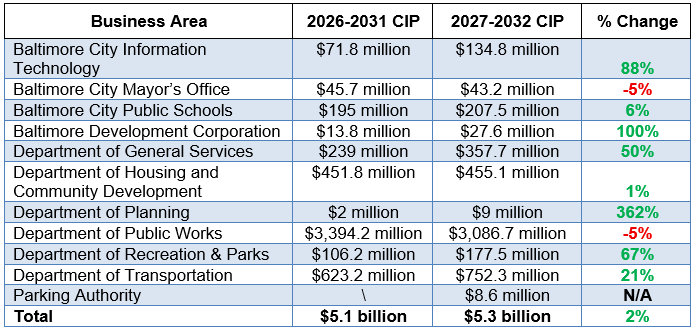
Spending Trend Summary
The updated CIP reflects a gradual rebalancing of capital priorities. While total program growth is modest, the internal composition shows reduced long-term commitments within major utility systems and stronger near to midterm investment in transportation corridors, public facilities, technology infrastructure, and environmental compliance programs. The significant structural shift in Department of Public Works stormwater related funding suggests regulatory or operational realignment that vendors should monitor closely. Growth in General Services and IT points to citywide modernization of municipal assets and systems. Overall, the trend reflects targeted reprioritization within a relatively stable capital framework—offering a runway for firms that can align with Baltimore’s evolving infrastructure and service delivery priorities.
Top 3 Projects 2027-2032 CIP
- West Baltimore United (Transportation) – $184.8 million, a plan for deconstruction and redevelopment of targeted areas in West Baltimore. This multiyear initiative addresses the legacy of highway infrastructure that divided communities for decades and is designed to reconnect neighborhoods, support economic development, and create space for future transit-oriented development. For vendors, this represents a complex, phased opportunity spanning demolition, site preparation, infrastructure rebuilding, and long-term placemaking work, with strong community and federal funding dimensions.
- SC 1032 Back River WWTP Activated Plant 3 Rehabilitation (DPW: Wastewater Division) – $161 million, rehabilitation of treatment components including final clarifiers and return activated sludge pumping systems. This signals ongoing major investment in Baltimore’s wastewater treatment infrastructure, creating opportunities for specialized firms in process equipment, controls, and largescale rehabilitation of aging treatment facilities.
- Vacancy Reduction Priority Geography (Housing & Community Development) – $136 million, acquisition and redevelopment of vacant properties and lots in priority neighborhoods. This investment reflects Baltimore’s strategic focus on stabilizing and revitalizing distressed neighborhoods through targeted acquisition and redevelopment, opening pathways for firms in demolition, site remediation, housing construction, and community infrastructure.
City of Baltimore Capital Plan Approval and Governance
Baltimore’s Capital Improvement Program (CIP) is governed by the City Charter and is updated annually as part of the City’s budget process. The Planning Commission develops and recommends a six-year CIP to the Board of Estimates (BOE), which oversees fiscal policy and budget formulation and then adopts and transmits the Ordinance of Estimates to the City Council. The first year of the CIP becomes the City’s Capital Budget within that Ordinance of Estimates, and the City Council adopts the Ordinance (typically by late June) to approve the budget for the coming fiscal year. The Charter also requires the BOE to consider recommendations from the Planning Commission, Director of Finance, and Board of Finance before including capital projects in the proposed Ordinance. For vendors, this multistage process creates several visibility points: Planning Commission deliberations (typically January–March), Board of Estimates approval (typically May), and City Council adoption (typically June). Tracking these milestones and engaging early in the Planning Commission review phase allows firms to see opportunities forming and align outreach before projects move into procurement.
Source: City of Baltimore Board of Estimates: https://www.baltimorecity.gov/comptroller/about/board-of-estimates, City of Baltimore Article VI Board of Estimates: https://codes.baltimorecity.gov/us/md/cities/baltimore/charter/VI
City of Baltimore’s History
Baltimore was established in 1729 as a Maryland port town and grew quickly through shipping and industry, leveraging its harbor and inland connections to become a major commercial center. In the War of 1812, Baltimore’s successful defense—most famously at Fort McHenry in September 1814—inspired Francis Scott Key’s “The Star Spangled Banner.” Through the 19th century, Baltimore expanded as a hub for manufacturing, rail, and maritime trade, shaping its dense urban neighborhoods and waterfront economy. A defining turning point came with the Great Baltimore Fire of February 1904, which devastated much downtown but also led to large scale rebuilding and modernization. In the 20th and 21st centuries, Baltimore continued to evolve through port activity, civic reinvestment, and the growth of major institutions such as higher education and healthcare.
Source: Britannica – Baltimore, Maryland History: https://www.britannica.com/place/Baltimore, The Start-Spangled Banner: https://www.nps.gov/fomc/learn/historyculture/the-star-spangled-banner.htm
Fun Facts about City of Baltimore
- Birthplace of the National Anthem US – The U.S. national anthem, “The Star Spangled Banner,” was inspired by the defense of Fort McHenry during the War of 1812, and visitors can tour the historic fort.
- Home of the First American Railroad – The Baltimore & Ohio Railroad (B&O), founded in 1827, was the first commercial railroad in the United States. Today, the B&O Railroad Museum preserves this pioneering transportation history.
- Famous for Maryland Blue Crabs – Baltimore is nationally known for its steamed blue crabs seasoned with Old Bay, a culinary tradition deeply tied to the Chesapeake Bay.
- More Than 200 Unique Neighborhoods – Baltimore is often called the “City of Neighborhoods,” with over 200 distinct communities offering diverse culture, architecture, and local character.
- Iconic Inner Harbor – The Inner Harbor is one of America’s most recognized waterfront revitalization projects, featuring attractions, museums, dining, and scenic harbor views.
Source: National Park Service: https://www.nps.gov/fomc/index.htm, A Tour of Baltimore’s Inner Harbor: https://baltimore.org/what-to-do/museums-attractions/a-tour-of-baltimores-inner-harbor/, Little Baltimore’s Neighborhoods: https://livebaltimore.com/neighborhoods/
How FirmoGraphs Can Help
FirmoGraphs curates data about U.S. public sector markets, including capital improvement programs, transportation plans, regulatory developments, and other critical information. We help our customers use this intelligence to gain a competitive advantage and improve proactive conversations with their clients. We’d be glad to meet with you and help your company navigate the wealth of information in capital plans and other publicly available documents. Feel free to request a meeting and review the data live on our Business Intelligence platform.