



Santa Barbara County, California, 2027–2031 Capital Improvement Plan (CIP) Alert
All dollar amounts are rounded to the nearest million. Source data: Santa Barbara County CIP project files (2026–2030 and 2027–2031).[1]
FirmoGraphs tracks capital improvement plans for counties, cities, and agencies across the United States to help architecture, engineering, and construction (AEC) firms identify upcoming project opportunities early.
In the CIP covering fiscal years 2027–2031, Santa Barbara County, California details plans to spend $850.3 million on capital projects — a 3.1% increase from $824.7 million in the prior 2026–2030 CIP.
The current plan carries 192 distinct projects, one more than the 191 in the prior cycle, signaling stable planning activity with modest growth in total investment.
How Did Santa Barbara County’s Capital Spending Change Between the Last Two CIPs?
| Metric | 2026–2030 CIP | 2027–2031 CIP | Change |
|---|---|---|---|
| Total CIP Value | $824.7M | $850.3M | +$25.6M (+3.1%) |
| Distinct Project Count | 191 | 192 | +1 (+0.5%) |
| Average Project Value | $4.3M | $4.4M | +$0.1M (+2.6%) |
Santa Barbara County’s latest capital plan reflects a steady, measured growth trajectory. The 3.1% increase in total planned capital spending — from $824.7 million to $850.3 million — indicates continued investment in infrastructure without dramatic expansion or contraction. The nearly unchanged project count (191 to 192) suggests the County is largely rolling forward a similar portfolio rather than introducing sweeping new priorities.
Below the headline totals, however, significant category-level shifts show that the County is reallocating investment. Streets and Roads climbs sharply as the dominant category, while Public Safety Facilities and Health Care Facilities see notable reductions. Dams, Levees, and Flood Control nearly doubles, reflecting the County’s attention to water management and climate-resilient infrastructure.
Which Departments and Business Areas Saw the Largest Changes in Santa Barbara County’s CIP?
| Business Area | 2026–2030 CIP | 2027–2031 CIP | Change ($) | Change (%) |
|---|---|---|---|---|
| Streets and Roads | $155.9M | $258.0M | +$102.1M | +65.5% |
| Public Spaces and Neighborhoods | $223.8M | $142.3M | −$81.5M | −36.4% |
| Dams, Levees, Stormwater and Flood Control | $61.1M | $121.8M | +$60.7M | +99.2% |
| Public Safety Facilities | $95.8M | $40.8M | −$55.0M | −57.4% |
| Health Care Facilities | $74.6M | $26.6M | −$48.0M | −64.3% |
| All Business Areas (Total) | $824.7M | $850.3M | +$25.6M | +3.1% |
Key spending shifts in the 2027–2031 CIP include:
- Streets and Roads is the largest gainer in absolute terms, rising $102.1M (+65.5%) to $258.0M — now the single largest category in the CIP, driven by road maintenance and improvement programs.
- Dams, Levees, Stormwater and Flood Control nearly doubles (+$60.7M, +99.2%), reaching $121.8M and reflecting the County’s ongoing commitment to flood resilience infrastructure.
- Public Spaces and Neighborhoods decreases by $81.5M (−36.4%) to $142.3M, suggesting a shift away from community facility investments in this cycle.
- Public Safety Facilities falls by $55.0M (−57.4%) and Health Care Facilities by $48.0M (−64.3%), likely reflecting the transition of previously planned major facilities into active construction or completion.
What are the Largest Projects in Santa Barbara County’s 2027–2031 CIP?
Santa Barbara County’s 2027–2031 CIP includes five large and strategically significant projects spanning public safety, transportation, flood control, and community infrastructure:
- North Branch Jail Expansion — $124.2M — This design-build project will expand the North Branch Jail to enable closure of the main portion of the Main Jail in Santa Barbara and address stipulated requirements from the Stipulated Judgement between the County and Disability Rights of California. Total estimated project cost is $171.2M with $4.2M unfunded. Anticipated completion: Summer 2029.
- Preventive Maintenance 5-Year Countywide Surface Treatment Program — $62.8M — A systemwide road surface treatment program to maintain the County’s road network across all regions.
- Probation, New Headquarters Building — $55.4M — A new headquarters facility for the County Probation Department.
- Bonita School Road Bridge Replacement — $47.1M — Replacement of the Bonita School Road Bridge, a major infrastructure project carried forward from prior planning cycles.
- Unfunded County Facilities Tenant Improvements — $35.9M — Countywide improvements to leased county facilities addressing deferred maintenance and tenant needs.
How is Santa Barbara County’s CIP Governed and Approved?
Santa Barbara County’s Capital Improvement Program (CIP) is a multi-year planning tool administered by the County’s General Services Department — Capital Projects Division. The CIP identifies and plans for both short-term and long-term capital needs, typically covering a five-year horizon and updated annually.
The process begins with departments submitting project nominations, which are evaluated for feasibility, funding, and strategic alignment by the County’s administrative and budget staff. Proposed allocations are subject to review and preliminary approval by the Santa Barbara County Board of Supervisors, which holds public hearings as part of the annual budget and CIP adoption cycle. The Board provides nonbinding conceptual approval for recommended one-time discretionary allocations prior to formal budget adoption. Final appropriations follow the County’s formal annual budget process.
For official CIP documents, visit the County of Santa Barbara Capital Improvement Program page.
What is the History of Santa Barbara County and Its Infrastructure Investments?
Santa Barbara County was established in 1850 as one of California’s original 27 counties, covering approximately 2,735 square miles of the Central Coast.[2]
With a population of approximately 448,000 as of the 2020 U.S. Census, the County encompasses the cities of Santa Barbara, Santa Maria, Lompoc, and Goleta, as well as numerous unincorporated communities.[2]
The county seat, the City of Santa Barbara, sits along the longest south-facing section of coastline on the West Coast of the United States, nestled between the Santa Ynez Mountains and the Pacific Ocean — earning it the nickname “The American Riviera.”[3]
The region’s history begins over 13,000 years ago with the Chumash people, whose ancestors inhabited the coast and Channel Islands long before European contact.[4]
Spanish settlement began with the founding of El Presidio Real de Santa Bárbara on April 21, 1782,[5] followed by the establishment of Mission Santa Bárbara on December 4, 1786 — the tenth of the California missions, today known as “The Queen of the Missions.”[6]
After the earthquake of June 29, 1925 devastated much of downtown Santa Barbara, the city undertook a remarkable rebuilding effort in the Spanish Colonial Revival style, creating the unified architectural character that defines it today.[7]
The county’s economy historically rested on agriculture, ranching, and petroleum, and later diversified into tourism, wine production, higher education (UC Santa Barbara), and aerospace and defense anchored by Vandenberg Space Force Base.
Fun Facts About Santa Barbara County
- Strawberries are the county’s top agricultural commodity — and have been for 22 consecutive years. In 2024, strawberry producers generated $860 million in gross value, representing more than 40% of the county’s total agricultural output of over $2 billion.[8]
- The city of Santa Barbara sits along the longest south-facing stretch of coastline on the West Coast of the United States outside of Alaska, creating the unique transverse valley geography that shapes its Mediterranean climate and world-class wine country.[3]
- Vandenberg Space Force Base, located in the county’s northern reaches near Lompoc, generates an estimated $4.5 billion in annual economic impact across Santa Barbara and San Luis Obispo counties and supports approximately 16,000 direct and indirect jobs — making it one of the region’s most significant economic assets.[9]
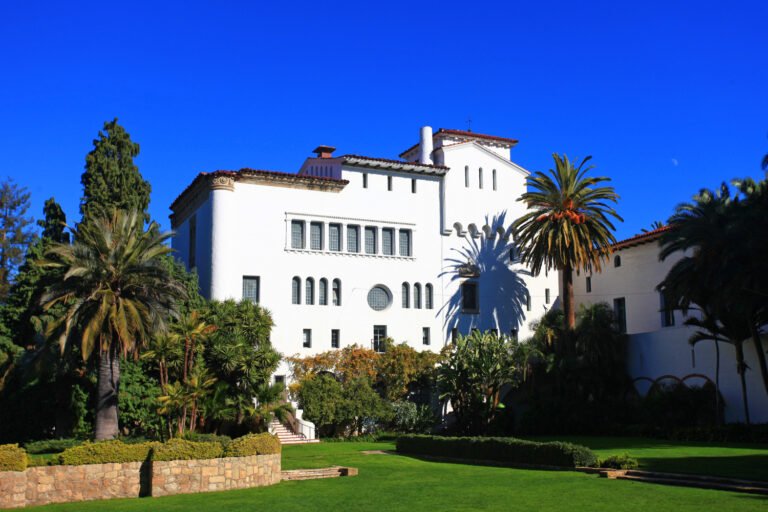
- The Santa Barbara County Courthouse, completed in 1929, is a stunning example of Spanish-Moorish Revival architecture designed by architect William Mooser. It was listed on the National Register of Historic Places in 1981 and designated a National Historic Landmark in 2005.[10]
- The 2004 film Sideways, filmed largely in Santa Barbara County wine country, helped put the region’s Pinot Noir on the global map — sparking a surge in wine tourism and contributing to what the industry dubbed “The Sideways Effect,” with Pinot Noir production in California increasing roughly 170% in the years following the film’s release.[11]
How FirmoGraphs Can Help
FirmoGraphs is a business intelligence and data science firm serving the United States heavy infrastructure and AEC markets. FirmoGraphs systematically tracks, maps, and analyzes Capital Improvement Plans from counties, cities, utilities, and public agencies across the United States — turning raw CIP data into structured, searchable intelligence for construction and engineering firms.
For AEC firms, general contractors, subcontractors, and suppliers active in Santa Barbara County and the broader California market, FirmoGraphs CIP intelligence helps identify upcoming project opportunities by sector, geography, and value — well ahead of formal solicitations. Whether you are tracking road maintenance programs, flood control projects, public facility construction, or parks and recreation investment, FirmoGraphs provides the early-stage visibility your business development team needs.
Ready to track Santa Barbara County and other CIPs in your market?
Request a meeting with FirmoGraphs to learn how our CIP tracking and market intelligence tools can support your pipeline development.
Santa Barbara County CIP Alert FAQs
References
- County of Santa Barbara, Capital Improvement Program page and County CIP project files for 2026–2030 and 2027–2031. https://www.countyofsb.org/3277/Capital-Improvement-Program
- Wikipedia, “Santa Barbara County, California.” https://en.wikipedia.org/wiki/Santa_Barbara_County,_California
- Wikipedia, “Santa Barbara, California.” https://en.wikipedia.org/wiki/Santa_Barbara,_California
- Britannica Kids, “Chumash.” https://kids.britannica.com/kids/article/Chumash/352960; Santa Barbara Museum of Natural History, “Chumash Life Timeline.” https://www.sbnature.org/collections-research/anthropology/chumash-life/timeline
- National Park Service / Mission history records: “El Presidio of Santa Bárbara was founded by Governor Felipe de Neve on April 21, 1782.” https://npshistory.com/brochures/nhl/old-mission-santa-barbara.pdf
- California Missions Foundation, “Mission Santa Bárbara.” https://californiamissionsfoundation.org/mission-santa-barbara/; Wikipedia, “Mission Santa Barbara.” https://en.wikipedia.org/wiki/Mission_Santa_Barbara
- Noozhawk, “How Buildings Became Safer After the 1925 Santa Barbara Earthquake.” https://www.noozhawk.com/how-buildings-became-safer-after-the-1925-santa-barbara-earthquake/; City of Santa Barbara, Spanish Colonial Revival Design Guidelines. https://santabarbaraca.gov
- Santa Maria Sun / Edhat, “Santa Barbara County Agriculture Exceeds $2 Billion in Value for 2024.” https://www.edhat.com/news/agricultural-production-worth-2-billion-in-santa-barbara-county-strawberries-remain-top-crop/; Santa Barbara County Agricultural Commissioner’s Office, 2024 Crop & Livestock Production Report.
- Santa Ynez Valley Star, “Vandenberg Space Force Base an Economic Boon in Two Counties.” https://santaynezvalleystar.com/study-vandenberg-space-force-base-an-economic-boon-in-two-counties/; REACH Central Coast Economic Impact Study, 2021.
- Wikipedia, “Santa Barbara County Courthouse.” https://en.wikipedia.org/wiki/Santa_Barbara_County_Courthouse; California Office of Historic Preservation. https://ohp.parks.ca.gov/ListedResources/Detail/1037
- Santa Barbara International Film Festival, “Sideways.” https://sbiff.org/sideways/; Wikipedia, “Sideways.” https://en.wikipedia.org/wiki/Sideways