



FirmoGraphs keeps its clients up to date on capital plans of interest for long-term business development. We help our customers use this information to gain a competitive advantage and improve proactive conversations with their clients. We recently processed the latest capital spending plan by the City of Syracuse; here are the key signals for firms selling into this market.
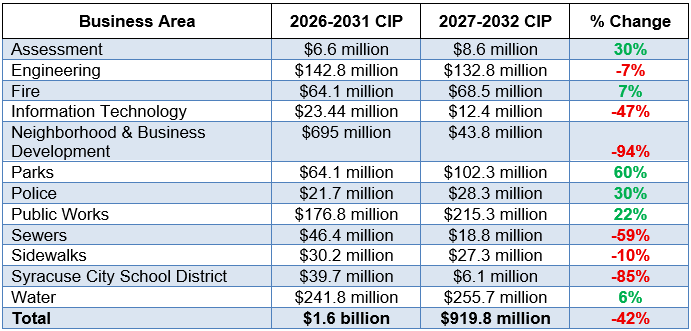
Between the City of Syracuse’s 2026–2031 and 2027–2032 Capital Improvement Programs (CIP), total planned investment declines from $1.6 billion to $919.8 million, a (-42%) reduction. The plan also contracts slightly in scope, from 165 projects to 160, indicating fewer total line items but still a broad program. The largest driver of this shift is Neighborhood & Business Development, which drops from $695 million to $43.8 million dollars (−94%), largely reflecting the presence of a single megaproject in the earlier plan. At the same time, Parks (+60%), Assessment (+30%), Police (+30%), Water (+6%), and Fire (+7%) increase, while Engineering, IT, Sewers, Sidewalks, and the Syracuse City School District see reductions. In effect, the new plan normalizes after a onetime spike, with less emphasis on large, Redevelopment driven investments and greater focus on core infrastructure, public safety, and parks. For vendors, this means fewer “all-or-nothing” megaprojects and steadier workstreams in streets, water, and public facilities.
Spending Trend Summary
The primary driver of the 42% decrease in total valuation is the normalization of Neighborhood & Business Development after the East Adams Transformation Plan rolls off. With that megaproject removed or reclassified, the new CIP is more balanced, emphasizing core systems rather than a single large redevelopment effort. Public Works and Police both show double digit growth, with Public Works’ increase driven by expanded road reconstruction and added facility upgrades such as the Salt barn at DPW ($3 million) and City owned Lighting ($7.7 million). The Water department remains the largest single area of investment, representing nearly 28% of the total budget, fueled by mandated lead service line replacements that will require sustained, programmatic delivery capacity. For vendors, the opportunity profile tilts toward recurring, infrastructure heavy programs—particularly water, streets, and related facilities—rather than one off mega projects in neighborhood redevelopment.
Top 3 Projects 2027-2032 CIP
- Lead Service Line Replacements ($150,000,000), A systemic program to replace lead water service lines for homeowners. The project replaces existing lines with copper (1 to 2inch) or cement lined ductile iron pipe (greater than 2inch) from the water main to the interior meter, supporting regulatory compliance, public health goals, and long-term system resilience.
- Road Reconstruction ($90,557,737), An annual program providing milling and paving of improved streets, defined as those with curbs. Streets with a rating of 5 will be milled and paved to add roughly 10 years of life, while streets rated 4 or below will be milled, paved, and receive base repairs to extend life by approximately 15 years. This structure creates an ongoing pipeline of work for firms focused on pavement renewal, rehabilitation design, and construction.
- Water Main Replacement ($60 million), A program to replace aging water mains and improve the reliability of water distribution and service to customers citywide. Replacement work is coordinated with street reconstruction projects when appropriate, creating integrated opportunities for vendors who can align water and street scopes efficiently.
City of Syracuse Capital Plan Approval and Governance
Syracuse’s Capital Improvement Program (CIP) is developed by City administration as a multiyear capital planning and financing tool and is reviewed and updated annually as needs and funding change. The CIP is formally presented to the Syracuse Common Council pursuant to the City Charter, where it enters the Council’s legislative review and oversight process. The Common Council serves as the City’s governing legislative body, reviewing and acting on City plans, budgets, and related initiatives, including capital plans and associated funding mechanisms. For vendors, this annual cycle administration development, Common Council presentation, and legislative review—creates a predictable window to track emerging projects and engage before they translate into procurement actions.
Source: Syracuse Capital Improvement Program: https://www.syr.gov/Departments/Budget/Capital-Improvement-Program
City of Syracuse’s History
Syracuse, in Central New York, grew from early1800s settlements near salty brine springs around Onondaga Lake—an industry that earned it the nickname “Salt City.” Its development accelerated with the Erie Canal (completed in 1825) and later railroads, which made it a significant transportation and manufacturing hub. Syracuse became a city on December 14, 1847, formed by combining the villages of Syracuse and Salina, and later diversified its economy as the salt industry declined in the late 1800s.
Source: Britannica – Syracuse New York page: https://www.britannica.com/place/Syracuse-New-York
Fun Facts about City of Syracuse
- Syracuse is called “Salt City” because it boomed from salt springs near Onondaga Lake, where brine was processed by boiling and evaporation in the 1800s, not from underground salt mines.
- The city is frequently cited as one of the snowiest U.S. cities due to intense lake effect snowfall off Lake Ontario.
- The Erie Canal Museum is housed in the 1850 Syracuse Weighlock Building, originally built to weigh canal boats and calculate tolls.
- Destiny USA is promoted as the largest entertainment and retail complex in New York State, offering hundreds of shopping, dining, and entertainment options year-round.
Sources: The Origins of “Salt City”: https://www.cnyhistory.org/2014/10/1353/, Syracuse Snowfall Totals & Accumulation Averages: https://www.currentresults.com/Weather/New-York/Places/syracuse-snowfall-totals-snow-accumulation-averages.php, 1850 Syracuse Weighlock Building: https://eriecanalmuseum.org/about/1850-syracuse-weighlock-building/, Destiny USA Mall: https://www.visitsyracuse.com/things-to-do/shopping/destiny-usa/
How FirmoGraphs Can Help
FirmoGraphs curates data about U.S. public sector markets, including capital improvement programs, transportation improvement programs, regulatory developments, and other critical public documents. We help our customers use this information to gain a competitive advantage and improve proactive conversations with their clients. We’d be glad to meet with you and help your company sort through the wealth of information in improvement programs and other publicly available records. Feel free to request a meeting and review the data live on our Business Intelligence Platform.
