


Waukesha County, Wisconsin, Planned Capital Spending Decrease By 29%
FirmoGraphs keeps its clients up to date on capital plans of interest for long-term business development. We help our customers use this information to gain a competitive advantage and improve proactive conversations with their clients. We recently processed the latest capital spending plan by the Waukesha County, Wisconsin. Here are our observations.
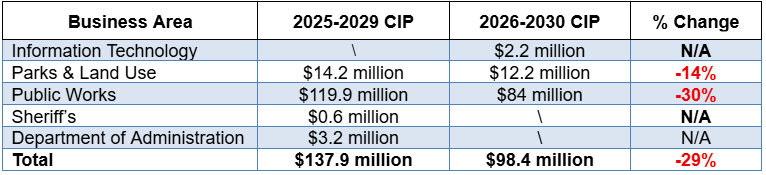
Waukesha County’s planned capital spending declines from approximately $137.9 million in the 2025–2029 Capital Improvement Plan (CIP) to $98.4 million in the 2026–2030 CIP, representing a reduction of about 29%. The total number of projects remains relatively stable (64 compared to 66), indicating that the decrease is driven primarily by scope reductions, project removals, and re-phasing of larger initiatives, rather than fewer projects overall. The capital program maintains its core infrastructure priorities while scaling back secondary expansions and selectively adjusting departmental capital commitments based on timing and funding strategy. The table below summarizes planned capital spending by business area across the two CIPs.
Spending Trend Summary
Across the two CIPs of Waukesha County, the spending mix remains heavily weighted to Public Works, but the newer plan shows a tighter focus on pavement cycles and phased courthouse work rather than broader expansion. Department of Administration and Sheriff-related capital activity tapers off, indicating fewer large modernization or public safety builds in the 2026–2030 window. Overall, the trend suggests more conservative scheduling of major projects and greater emphasis on timing, phasing, and lifecycle replacements.
Top 3 Projects – Waukesha County CIP 2026-2030
- Courthouse Project – Step 2: Renovate 1959 Courthouse (Public Works) – $20.5 million. Major renovation of the 1959 courthouse facility, continuing a multi-phase plan to modernize Waukesha County’s justice infrastructure. Supports updated security, accessibility, building systems, and space modernization for court functions and related services.
- Repaving Program 2028–2032 (Public Works) – $13.1 million. A multi-year repaving program focusing on the County Trunk Highway network. Designed to extend pavement life cycles, improve safety, and reduce long-term maintenance costs by prioritizing timely resurfacing of key corridors.
- Repaving Program 2023–2027 (Public Works, continuing funding window) – $9.5 million. Complements the 2028–2032 repaving initiative, covering the earlier portion of the planning horizon. Ensures consistent pavement conditions and integrates with traffic signal optimization and culvert replacement programs to support a holistic roadway infrastructure strategy.
Collectively, these three projects account for more than 40% of the 2026–2030 CIP’s total value, underscoring the central role of the courthouse modernization and highway programs in Waukesha County’s capital vision.
Waukesha County’s Capital Plan Approval and Governance
Waukesha County’s Capital Improvement Plan (CIP) is developed annually by departments and compiled into a proposed five-year plan by the County Executive. The proposal is reviewed and modified by County Board standing committees, then adopted by the full Board by resolution. The first year of the CIP becomes the official capital budget, while year’s 2–5 serve as a planning forecast and are re-evaluated each year. Throughout, staff monitor project status, costs, and debt impact, and adjustments are made in future CIPs to reflect changing priorities and fiscal conditions.
Sources: Waukesha County Capital Projects Plan: https://www.waukeshacounty.gov/news/posts/capital-projects-plan/, Waukesha Enrolled Resolution: https://www.waukeshacounty.gov/media/ftvlicc0/er-179-2.pdf
History of Waukesha County
Waukesha County, located in southeastern Wisconsin, was originally inhabited by Indigenous peoples including the Menominee, Potawatomi, Ojibwe, and Ho-Chunk nations. Euro-American settlement began in the 1830s, and the county was officially created in 1846 out of Milwaukee County as agriculture, milling, and small communities expanded along local rivers. Through the late 19th and early 20th centuries it evolved from a largely rural, farming region into a popular “Lake Country” and mineral-springs destination, later becoming a fast-growing suburban county within the Milwaukee metro area. Today it is one of Wisconsin’s most populous and economically significant counties, blending historic towns, lakes, and parkland with modern suburbs and industry.
Sources: Wikipedia – Waukesha County: https://en.wikipedia.org/wiki/Waukesha_County%2C_Wisconsin
Fun Facts about Waukesha County
Waukesha is the birthplace of Les Paul, the legendary guitarist and inventor who helped pioneer the solid-body electric guitar and multitrack recording, transforming modern music.
The Waukesha County Fair is the oldest fair in Wisconsin, held each July at the Waukesha County Expo Center. Recent fairs have celebrated more than 175 consecutive years of county fair tradition.
The county includes a region popularly called “Lake Country”, with numerous lakes such as Pewaukee Lake and Nagawicka Lake, making boating, fishing, and waterfront recreation central to local identity and tourism.
In statewide elections, Waukesha County is one of Wisconsin’s key suburban counties and often described as part of the influential “WOW” counties (Washington, Ozaukee, Waukesha). While this report focuses on infrastructure and capital spending, the county’s political profile frequently draws national attention.
Sources: Waukesha County Facts for kids: https://kids.kiddle.co/Waukesha_County%2C_Wisconsin, Waukesha Village, Wisconsin: Interesting Facts, History Information & Travel Guide Blog: https://www.hollymelody.com/blog/usa/wisconsin/waukesha-village-wisconsin-interesting-facts-history-information-travel-guid, Wikipedia – Waukesha County: https://en.wikipedia.org/wiki/Waukesha_County%2C_Wisconsin
How FirmoGraphs Can Help
FirmoGraphs curates data about U.S. public sector markets, including transportation improvement programs, regulatory developments, and other critical information. We help our customers use this information to gain a competitive advantage and improve proactive conversations with their clients. We’d be glad to meet with you and help your company sort through the wealth of information in improvement programs and other publicly available documents. Feel free to request a meeting and review the data live on our Business Intelligence platform.